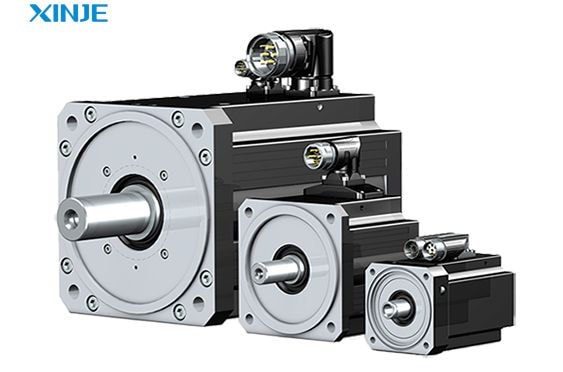
What is a servo motor? A servo motor is a rotary or linear actuator that allows precise control of angular or linear position, velocity, and acceleration. These motors are often part of a closed-loop system where feedback mechanisms, such as encoders or decoders, continuously report the motor position to the controller for real-time adjustment.
Servo motors play a vital role in achieving precise motion and controlled performance. Whether it is a robot, CNC machine, conveyor system, or pick and place equipment, servo motors are trusted for their precision, reliability, and speed control.
What is the function of a servo?
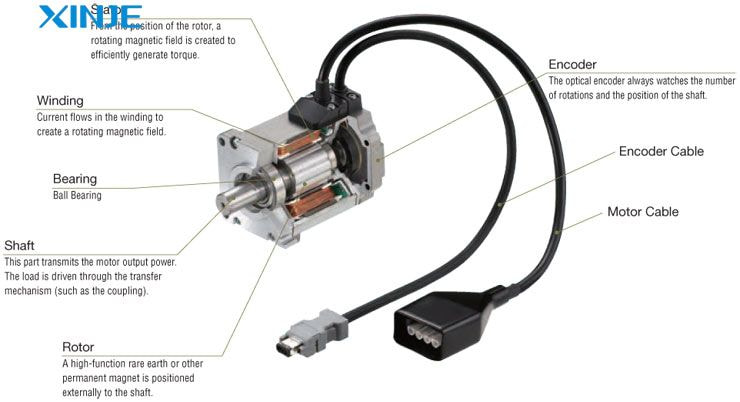
The primary function of a servo motor is to convert electrical energy into mechanical motion with high precision and control. Unlike traditional motors that run continuously when powered, servo motors are designed for precise and targeted motion, responding precisely to control signals. The primary functions of a servo motor include:
- Position control: Servo motors ensure that machine parts move to a precise position and stay there. This is essential in robotic arms, packaging machines, and CNC milling machines.
- Speed regulation: They can start, stop, and change speed quickly without sacrificing accuracy.
- Torque control: Servo systems can control torque output, making them suitable for applications where force feedback is critical.
- Feedback: Servo motors use sensors to continuously monitor output and make adjustments in real time, ensuring high performance and efficiency.
In automation systems, servo motors work behind the precise motion, allowing for synchronous motion and repeatability that standard motors cannot achieve.
What is the working principle of a servo motor?
The operating principle of a servo motor revolves around a closed-loop control system. And the operating principle is described through a detailed process as follows:
- Command signal input: The system receives a signal from the controller, specifying the desired position, speed, or torque.
- Motor activation: The servo drive interprets this signal and supplies power to the servo motor accordingly.
- Feedback mechanism: An encoder or decoder mounted on the motor shaft continuously monitors the position.
- Comparison: The controller compares the actual position with the commanded input.
- Error correction: If there is a discrepancy (error), the system automatically adjusts to minimize the error in real time.
A repeatable operating process of continuous monitoring and adjustment allows the servo motor to maintain high precision and dynamic response, even when the load fluctuates.
What is the main disadvantage of a servo motor?
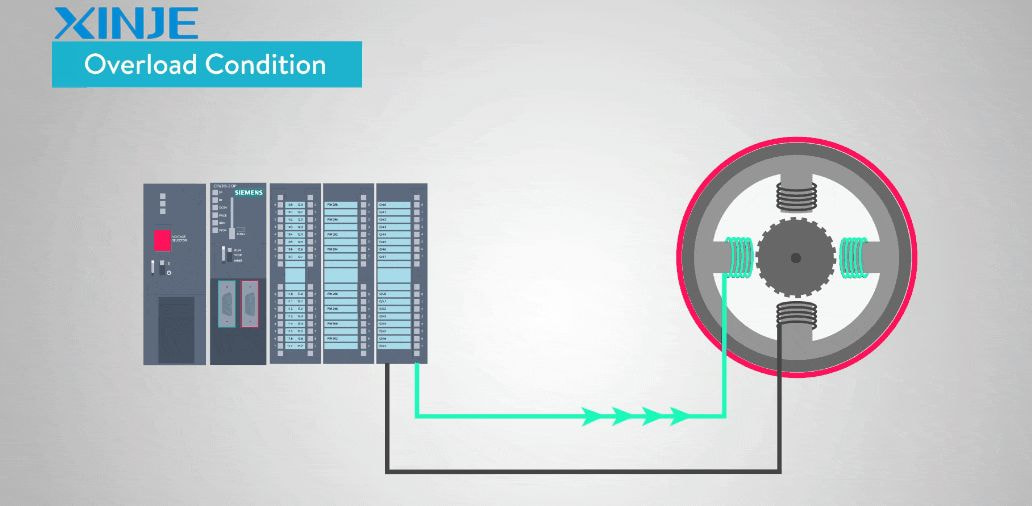
Servo motors are like any other industrial device. Despite their advantages and impressive performance, servo motors also have some limitations.
- High initial cost: Servo motors and their associated drives are significantly more expensive than standard motors. The additional investment in encoders, controllers, and software integration makes them less attractive for simple applications.
- Complex setup and tuning: Servo systems require fine-tuning of parameters such as PID gain, speed curves, and torque limits. Improper tuning can lead to instability, vibration, or poor performance.
- Reliance on feedback devices: Without active feedback devices such as encoders, servo motors cannot operate accurately. If the feedback loop fails, accuracy will also be affected.
For applications where accuracy, repeatability, and speed are important factors, servo motors are well worth the investment despite these limitations.
How to check if a servo motor is working or not?
If your automation system is experiencing unexpected problems, the servo motor may be one of the first causes to consider. Here is a step-by-step guide to checking if the servo motor is working properly:
- Check the power supply: Make sure the servo motor is receiving the correct voltage from the servo drive or power supply. Use a multimeter to measure the voltage at the inputs.
- Check the encoder/feedback: If using a feedback encoder, confirm that the signal is being sent correctly to the controller. Many servo drives will display an error code if feedback is lost.
- Check the rotation: Using the servo drive’s control interface, try running the motor through. If the motor does not rotate or gives an error signal, further testing is needed.
- Run Self-Test or Diagnostics: Modern servo drives are equipped with diagnostic features that can check the motor health, encoder response, and motor temperature in real time.
If any abnormalities are detected, the operator may need to recalibrate the servo, replace the faulty encoder, or service the entire motor. If the cause is still not found, contact the maintenance department for repair and inspection.
What is the main difference between a servo motor and a normal motor?
At first glance, servo motors and traditional AC or DC motors may seem similar, but their functions, designs, and applications are very different. Some typical differences that users need to distinguish are as follows:
| Feature | Servo motor | Normal motor |
| Precision | High (accurate position/speed/torque) | Low to moderate |
| Application | Automation, robotics, CNC, packaging | Fans, pumps, conveyors, blowers |
| Speed Regulation | Excellent | Limited |
| Response Time | Fast and dynamic | Slower |
| Setup Complexity | Moderate to High | Low |
Conclusion
In summary, Servo motors are at the heart of modern automation systems, providing superior control of motion, speed, and torque. Their closed-loop feedback, precise response, and high-speed operation make them ideal for advanced applications in robotics, manufacturing, and process automation.
Although they are more expensive and require careful installation, the performance benefits far outweigh the drawbacks, especially in industries that require precision and reliability. By understanding how servo motors work, what they do, and how to troubleshoot them, engineers and automation professionals can make informed decisions when designing or maintaining automated systems.